

When reviewing costs for next year, most businesses focus on energy, materials and labour. But there’s one vital resource that often escapes scrutiny: water.
Water isn’t just a utility bill—it’s a hidden cost centre with significant financial and environmental impact. And if it’s not in your budget conversations right now, you could be missing major savings opportunities.
If you’re stuck for time – Download Our Free Guide: Quick Wins for the Food & Beverage Industry
The Hidden Layers of Water Costs
Water costs rarely stop at the mains meter. Behind that utility bill is a complex chain of processes, each carrying financial and environmental implications:
💰 Procurement Costs
Water supply charges, standing fees, metering and the energy needed for pumping across your site.
⚙️ Treatment Costs
Most process water needs conditioning before use. Filtration, softening, chemical dosing and heating all consume energy and materials.
📋 Effluent and Discharge Costs
Trade effluent fees, compliance testing, sampling and potential penalties for exceedances can significantly increase costs.
🗑️ Sludge Management Costs
Handling, dewatering, transport and disposal of sludge from wastewater treatment adds another layer of expense and carbon emissions.
The reality? The true cost of water can be several times higher than what appears on your utility bill.
Why This Matters for Your 2026 Budget
Understanding the full lifecycle of water creates opportunities to:
✅ Reduce operating costs by 20 to 40 per cent through water reuse and recycling
✅ Lower energy consumption across treatment and pumping systems
✅ Improve compliance and avoid environmental penalties
✅ Cut waste and emissions through optimised sludge handling
✅ Meet ESG and net zero objectives with measurable results
What You Should Be Doing Right Now
Budget season is your opportunity to get ahead. Before finalising your 2026 plans, take these critical steps:
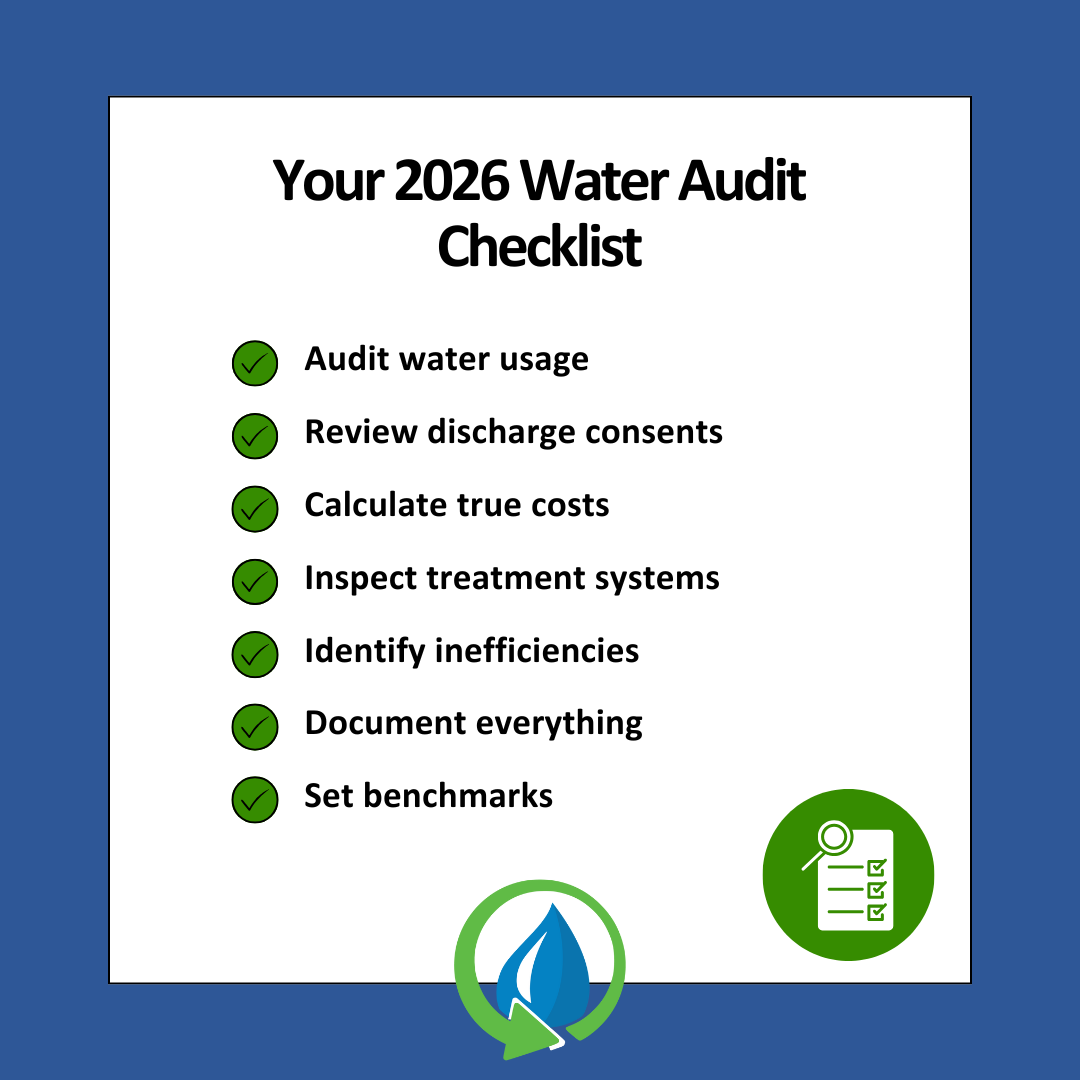
🔍 Audit Your Current Water Usage
Document every stage from procurement through to discharge. Map out where water enters your site, how it’s treated, where it’s used and how it leaves. Include all associated costs: standing charges, trade effluent fees, chemical usage, energy consumption and sludge disposal.
📊 Review Your Discharge Consents
Check your current discharge limits and recent sampling results. Are you operating close to consent limits? Have regulations tightened? Understanding your compliance position now prevents costly surprises later.
💰 Calculate Your True Water Cost
Add up procurement, treatment, discharge and sludge management costs. Most businesses find the total is far higher than expected. This figure becomes the baseline for measuring improvement.
⚙️ Inspect Your Treatment Systems
When did you last assess your wastewater treatment plant’s performance? Document its age, condition, efficiency and any operational issues. Note recurring problems, maintenance frequency and whether the system struggles during peak production.
📈 Identify Inefficiencies
Look for water being used once and discharged, excessive chemical dosing, high energy consumption in pumping or treatment, and oversized sludge disposal costs. Each of these represents a potential saving.
📋 Document Everything
Create a comprehensive record of your water and wastewater operations. This documentation becomes essential when building business cases for capital investment or demonstrating ROI to finance teams.
🎯 Set Benchmarks
Establish clear metrics: cost per cubic metre, energy per cubic metre treated, sludge disposal cost per tonne, compliance incidents per year. These benchmarks let you measure progress and justify investment
The Budget Conversation You Need to Have
Armed with this information, you can have informed discussions about 2026 capital allocation:
- What investment would reduce operating costs by 20 to 40 per cent?
- How much would improved efficiency save over five years?
- What’s the risk cost of non compliance or system failure?
- How does wastewater treatment investment support ESG commitments?
Modern wastewater treatment technologies can transform water from a cost drain into a recoverable asset. Effluent treatment plants enable safe reuse, reducing mains water demand. Energy efficient sludge dewatering cuts disposal volumes and transport costs. Automated control systems optimise performance whilst reducing energy use. Real time monitoring identifies inefficiencies before they become expensive problems.
Don’t Wait Until It’s Too Late
The challenges you’re experiencing today with your wastewater treatment system won’t improve on their own. Peak production periods, tightening regulations and rising utility costs will only increase the pressure.
Right now, whilst budgets are still being finalised, you have the opportunity to:
✓ Build a compelling business case based on documented costs and inefficiencies
✓ Demonstrate clear ROI that makes investment approval easier
✓ Plan upgrades during scheduled downtime rather than emergency shutdowns
✓ Position your operation for a more efficient, compliant and sustainable 2026
How Water Tecnik Can Help

Once you’ve completed your audit and review, we can help you turn those findings into action.
At Water Tecnik, We design, manufacture, and maintain treatment solutions that help industrial and manufacturing facilities meet discharge standards, reduce spend, and stay ahead of regulators. From manufacturing and food processing to public utilities and beyond, we deliver efficient, sustainable water treatment solutions for every sector.
Whether you need a full system audit, help building your business case or a complete treatment plant upgrade, we’re here to support your journey towards lower costs, better compliance.
Don’t let wastewater treatment be an afterthought in your planning. Start your review today.
📩 Need support turning your findings into action? Get in touch with Water Tecnik to discuss how we can help optimise your wastewater treatment for 2026 and beyond.